
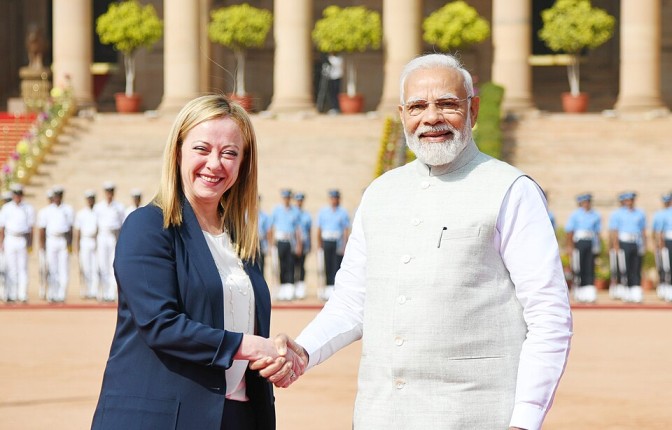
India and Italy have elevated their relationship to a special strategic partnership, with an ambitious goal to boost bilateral trade to €20 billion by 2029. This development came as Indian Prime Minister Narendra Modi and Italian Prime Minister Giorgia Meloni engaged in discussions aimed at reinforcing a rules-based international order against the backdrop of global conflicts and geopolitical challenges. The leaders expressed concerns about ongoing conflicts in Ukraine and West Asia, emphasizing the need for de-escalation and diplomacy to achieve lasting peace. They also highlighted the importance of ensuring freedom of navigation and the resumption of shipping through the Strait of Hormuz.
Prime Minister Modi was in Rome as part of a five-nation tour focusing on enhancing India’s energy security and cooperation in key sectors like defense, trade, investment, and technology. During their talks, Modi and Meloni agreed to capitalize on the forthcoming India-European Union (EU) free trade agreement, expected to be signed later this year. “I am delighted that we are upgrading our relations to a special strategic partnership,” Modi stated, highlighting the India-Italy joint strategic action plan for 2025-29 as a forward-looking framework for collaboration.
The agreement between the two nations will see an increased focus on trade, aiming to raise the current level from €14 billion to €20 billion by 2029. Meloni emphasized the strategic importance of collaboration between Italy and India in promoting freedom of navigation in the Indo-Pacific and connecting this region with the Mediterranean via the India-Middle East-Europe Economic Corridor (IMEC). Both leaders reaffirmed their commitment to dialogue and diplomacy as the means to resolve international tensions, with Meloni particularly advocating for a fair and lasting peace in Ukraine.
A new mechanism led by the foreign ministers of both countries will be established to review the joint strategic action plan for 2025-29, providing strategic direction for the special partnership. The collaboration will expand across various sectors, including trade, defense, science and technology, space, energy, artificial intelligence, and education. “Technology and innovation are the engines of our partnership,” Modi remarked, pointing to the potential for cooperation in areas such as AI, quantum computing, and civil nuclear energy. The development of an India-Italy Innovation Centre is underway to foster connections among startups, research centers, and industries from both countries.
Further emphasizing the defense sector, Modi noted the growing cooperation between Indian and Italian defense industries and militaries, facilitated by a defense industrial roadmap that supports co-development and co-production. Both nations have also agreed to enhance the mobility of students, researchers, and skilled workers, particularly in STEM fields, and to align skills development with labor market needs. A joint declaration of intent will facilitate the mobility of nurses from India to Italy, reflecting the deepening ties between the two countries.