
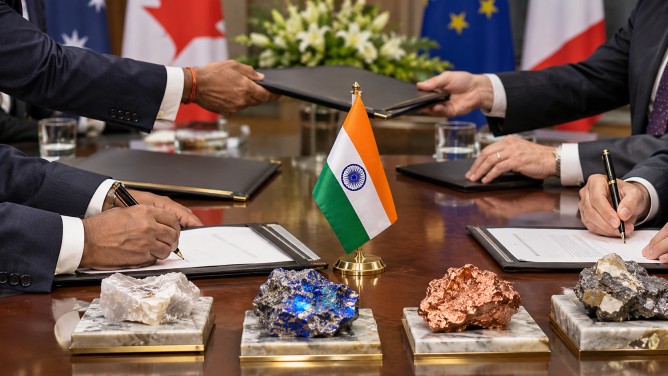
India has significantly bolstered its position in the global race for critical minerals essential to clean energy technologies by signing 15 international agreements since January 2025. This move places India ahead of China, Canada, Saudi Arabia, and the European Union, which have each signed 11 agreements, though still trailing behind the United States, which leads with 41 agreements. These deals aim to secure vital resources such as lithium, cobalt, nickel, graphite, copper, and rare earth elements crucial for the production of electric vehicle batteries, wind turbines, semiconductors, and electricity infrastructure.
With the launch of the National Critical Mineral Mission, India is expanding its international partnerships to reduce dependency on foreign suppliers while enhancing domestic exploration, processing, manufacturing, and recycling capabilities. The government has allocated Rs 16,300 crore to the mission, which seeks to attract an additional Rs 18,000 crore in investment. Under this initiative, India plans to conduct 1,200 domestic exploration projects and acquire overseas mining assets through both public and private enterprises.
India’s state-owned Khanij Bidesh India Ltd has entered into a partnership with Argentina’s CAMYEN to explore five lithium blocks covering 15,703 hectares. Additionally, India has explored joint investment opportunities in lithium and cobalt with Australia and strengthened its cooperation with Germany and Norway. These efforts reflect a broader global trend, as nations increasingly sign cooperative agreements to secure mineral supplies and develop their domestic processing industries.
Despite these advancements, there are concerns over transparency, as analysis indicates that 39 percent of critical minerals agreements do not have publicly available texts. This lack of transparency poses challenges for stakeholders seeking to understand the full scope and implications of these deals.
The heightened competition for critical minerals underscores the necessity for India to not only acquire raw materials but also to enhance its domestic manufacturing capabilities. Developing sustainable supply chains, creating employment opportunities, and fortifying industrial capacity are imperative as the global demand for clean energy technologies continues to rise. By building a robust domestic infrastructure, India can better position itself to meet future energy needs and contribute to the global clean energy transition.